Warde / SailPoint
ServiceNow and SailPoint,
on a supported connector.
Staff ask for access in your ServiceNow portal, approvals run in ServiceNow, and SailPoint provisions the change. Warde does the ServiceNow half for Identity Security Cloud and IdentityIQ, in place of an integration somebody built years ago.
One path from the request to SailPoint and back.
SailPoint stays the system of record. Your role model, policies and separation-of-duties rules stay there.
01 · Your portal
Ask
Staff search by name and put several applications in one request. What they hold is marked.
02 · ServiceNow
Approve
Your approval policy picks the approvers in order. A bundle is approved once.
03 · SailPoint
Provision
SailPoint makes the change the way it already does. Warde shows the requester a promised date.
04 · ServiceNow
Confirm
The request reads done only when SailPoint confirms it. Removals and review decisions take the same path.
Separation of duties, checked by SailPoint before approval.
Warde holds no rules of its own. It asks SailPoint, and you choose whether a conflict warns the approvers or blocks the line.
Identity Security Cloud
Warde asks ISC which policies each line would break, counting the person’s other open requests. Approvers see each policy by name, with the access on each side.
IdentityIQ
Each line goes to IdentityIQ’s own policy check, with the person’s other open requests, before anyone approves.
Warde next to SailPoint’s own ServiceNow applications.
A tick means the work happens in ServiceNow. A dash usually means SailPoint does it in its own console.
| In ServiceNow | Warde | SailPoint for ISC | SailPoint for IdentityIQ |
|---|---|---|---|
| Ask for access in the ServiceNow catalog | yes | yes | yes: roles |
| Approve it in ServiceNow | yes | yes | yes: ServiceNow manager approvals, or an IdentityIQ workflow |
| Checked before it is sent: separation of duties, terms of use and the owner’s notes | yes: terms of use and the owner’s notes wherever they are set, and SailPoint’s separation-of-duties verdict | partly: separation of duties is checked on the form, set to warn or block, and the details reach approvers; terms of use and owner’s notes are not documented | partly: a separation-of-duties error on the form, with the step to fix it; terms of use and owner’s notes are not documented |
| SailPoint does the provisioning | yes | yes | yes |
| Time-bound access: an end date on the request, within a limit you set, with a warning before it ends | yes | partly: a sunset date on the form, which can be made mandatory; Identity Security Cloud removes the access and emails its own reminders | partly: start and end dates on the request, and IdentityIQ removes the access; warnings are not documented |
| Removing access in ServiceNow, by the holder or their manager, confirmed back | yes | partly: a manager can remove a direct report’s access, but people cannot remove their own over the usual connection | yes: Remove Access lists a person’s roles and entitlements, who may remove follows IdentityIQ’s rights, and a task closes the request |
| User access reviews decided in ServiceNow | yes | yes: SailPoint documents a certification portal in ServiceNow where certifiers approve, revoke and sign off | no: the IdentityIQ integration does not include it |
| Campaigns defined and scheduled in ServiceNow | yes | their console | their console |
| Approval policies built in ServiceNow | yes | no | no |
| Access bundles curated in ServiceNow | yes | no | no |
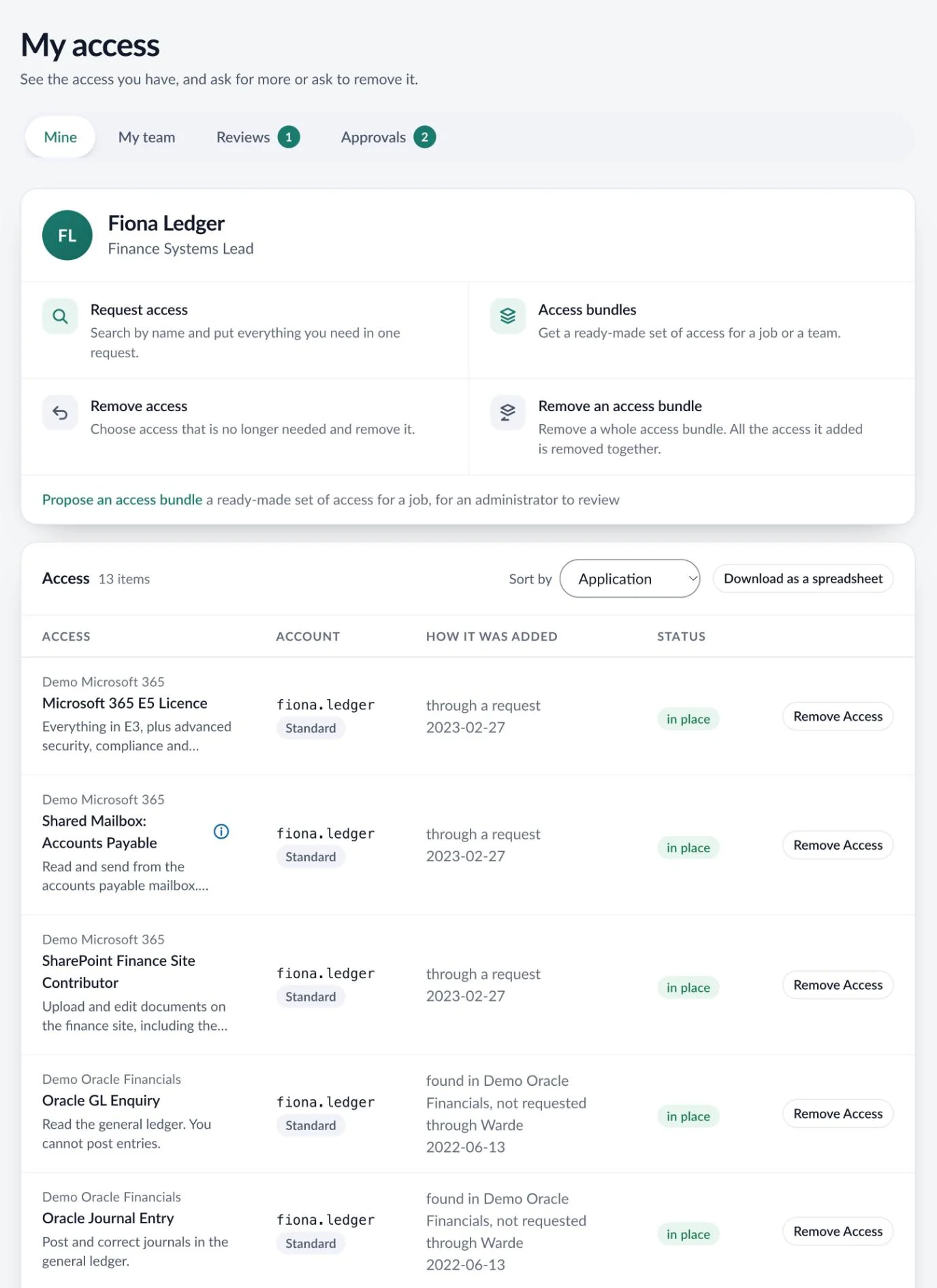
| My Access: one page for what you and your team hold, and the reviews waiting on you | yes | partly: the app shows the roles and access profiles a person holds, without a team view or reviews on the same page | not stated |
| An admin workspace on the instance: what is stuck, what is stale, connector health | yes | not stated | not stated |
| The auditor’s evidence pack, in ServiceNow | yes | no | no |
| Applications SailPoint does not reach, run the same way | yes: provisioned by ServiceNow tasks | no | no |
| Spots the joiner and the leaver for you | not on its own: your joiner and leaver trigger calls Warde’s lifecycle endpoint, and Warde provisions from there | yes | yes |
How we read the vendor
SailPoint columns are read from SailPoint’s published documentation in October 2026. A dash means the work is done in SailPoint’s console, or the documentation does not say it is done in ServiceNow. On the last row, SailPoint watches your HR source itself; Warde is called by whichever system already knows somebody has joined or left.
If somebody built your integration years ago.
Many SailPoint customers run a home-built link: a catalog item per application, scripted REST calls, and one person who remembers how it works. Warde replaces it with a supported app from the ServiceNow Store, updated as one versioned release.
Applications and entitlements are read from SailPoint and keep SailPoint’s names. Everything is requested from one form, with no catalog item to build. Your IAM team runs it with three wizards and no developer.
Both SailPoint platforms.
Identity Security Cloud
Reads sources, entitlements, access profiles, roles and who holds them. Each change goes in as an access request, and Warde waits for ISC to confirm it.
IdentityIQ
Reads applications, entitlements, roles and accounts. Each change runs through IdentityIQ’s own provisioning workflow, with its policy check before approval.
Moving from one to the other
Warde can use both while applications move across, so staff keep the same form, reviews and My Access.
End dates follow SailPoint’s rules.
Limits from ISC
Where ISC requires an end date or caps how long access lasts, Warde applies the same limit. The form asks for the date and refuses a longer one before anyone approves.
Removed on time
ISC removes a role on its own end date. Warde removes entitlements and access profiles when theirs pass, and on IdentityIQ, which keeps no end dates, everything time-limited.
Later start dates
Access ISC gives with a start date ahead counts as held from that date.
When SailPoint refuses, or goes quiet.
A change fails
It goes to your failure group as one task, naming the access, the person and what happened. The request stays open until it is settled.
SailPoint is down
Grants and removals are held and sent once it recovers. People can still request and approve. Work held two days goes to a person.
ISC never finishes
After two days Warde stops checking, asks ISC to cancel the request, and puts ISC’s answer on the task.
Questions about SailPoint
Does Warde replace SailPoint?
No. SailPoint holds the role model and the policies, and it provisions. Warde puts the request, the approval and the review in ServiceNow.
Do I still need SailPoint’s Service Catalog app?
Not for access requests. Keep SailPoint’s Identity Governance Connector if SailPoint governs who holds roles inside ServiceNow itself, because that is a different job.
Does it need IntegrationHub or a MID Server?
No IntegrationHub and no paid ServiceNow subscription. An IdentityIQ server inside your network needs a route from the instance, such as a MID Server.
Can a request reach SailPoint twice?
No. If SailPoint does not answer, Warde looks for the request instead of sending it again, and hands it to a person if it cannot find it.
How current is what Warde shows?
Accounts, applications and entitlements are read in full each night, and who holds what each night, with a full read of it at the weekend. An administrator can sync at any time.
Do we keep ISC’s approval steps?
Clear them on the items Warde manages, or each change is approved twice. Engine health names any item that still has one.
What about accounts SailPoint has not matched to a person?
They show as orphan accounts, with the reason, and cannot be used in requests. Correlate them in SailPoint and the next sync picks them up.
More of Warde
Bring the SailPoint request your users hate most.
Forty-five minutes on a live instance, connected to SailPoint, with no slides.
Warde is priced per user. Book a walkthrough or get in touch for a quote.